E G B D F

catronauts
Sep 13, 2025 · 6 min read
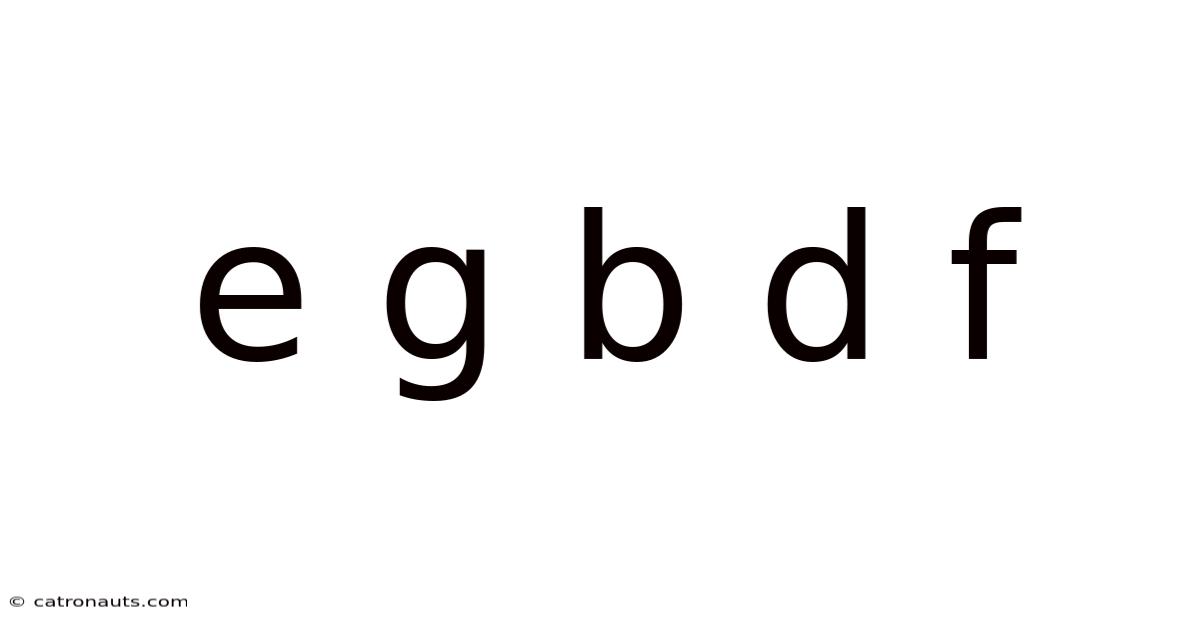
Table of Contents
Decoding the Enigma: A Deep Dive into the EGBDF Sequence
The seemingly simple sequence EGBDF – often encountered in music theory – holds a surprising depth of meaning and historical significance. This article will explore this musical pattern from its humble beginnings to its complex implications within musical composition, theory, and even popular culture. Understanding EGBDF provides a foundational knowledge for anyone seeking to delve deeper into the world of music. We’ll explore its connection to the solfege system, its role in diatonic scales, and its enduring legacy in musical education.
The Solfege System: The Birthplace of EGBDF
The sequence EGBDF is intrinsically linked to the solfege system, a method of teaching music theory that uses syllables to represent the notes of a scale. This system, dating back to the 11th century, assigns a specific syllable to each degree of the diatonic scale: do, re, mi, fa, sol, la, ti, do. In English-speaking countries, these syllables are often adapted as do, re, me, fa, so, la, ti, do. While the modern English adaptation uses "so," the original and still widely used Italian equivalent utilizes “sol.” This is where our EGBDF sequence becomes relevant.
Within the solfege system, the notes E, G, B, D, and F represent the perfect intervals within a major scale. More specifically, they represent the perfect fifth (G), major third (B), and perfect fourth (D) above the tonic (E). The F is the perfect fourth above the G. This precise relationship forms the backbone of much of Western musical harmony. The sequence elegantly demonstrates the building blocks of major chords, foundational to countless compositions. Understanding these perfect intervals allows one to grasp the essence of consonance and dissonance within music.
The Diatonic Scale: The Framework of EGBDF
The diatonic scale, the cornerstone of Western music, is built upon the intervals represented within EGBDF. Every major scale utilizes this pattern of whole and half steps (whole step: two semitones, half step: one semitone). The specific arrangement of these intervals allows for a musically satisfying and harmonically rich structure. The sequence is not merely an arbitrary grouping of notes, but a reflection of the inherent mathematical ratios and acoustic properties that underlie the pleasing sounds we experience in music.
Let’s look at a C major scale for a practical illustration:
- C (tonic) – D (major second) – E (major third) – F (perfect fourth) – G (perfect fifth) – A (major sixth) – B (major seventh) – C (octave)
Notice how E, G, B, D, and F appear within this scale – highlighting the fundamental role they play in creating a complete and balanced musical framework. These notes form the core of major chords in the C major key, such as the C major (C-E-G), G major (G-B-D), and F major (F-A-C) chords. The relationships between these notes define the essence of the key and its inherent harmonies.
Exploring the Sequence: Intervals and Chords
The EGBDF sequence isn't merely about individual notes; it emphasizes the crucial relationships between them. These relationships are expressed through intervals. Let's break down the intervals formed within the sequence:
- E to G: A major third (4 semitones) – a consonant and pleasant-sounding interval.
- E to B: A major sixth (9 semitones) – another consonant interval frequently used in melodies and harmonies.
- E to D: A minor second (1 semitone) – a dissonant interval often used to create tension and drama.
- G to B: A major third (4 semitones) – again, a consonant interval.
- G to D: A perfect fifth (7 semitones) – a very strong consonant interval, fundamental to harmony.
- B to D: A minor third (3 semitones) – a less consonant interval, often used strategically for color.
- B to F: A perfect fourth (5 semitones) – a consonant interval, adding to the richness of chords built upon these notes.
These intervals, when combined, form various chords. The notes within EGBDF are capable of producing different triads and seventh chords, each with its unique character and harmonic function. Experimenting with these combinations is a valuable exercise for anyone wanting to understand chord progression and harmony in a deeper context.
EGBDF in Musical Composition and Theory
The sequence EGBDF permeates musical compositions across genres and historical periods. Understanding its harmonic implications is key to analyzing and appreciating music. Composers often use this sequence to create pleasing melodies, develop strong harmonic progressions, and establish a sense of key and tonality. The sequence is not explicitly stated in most scores, but its implicit influence is undeniable. By recognizing the harmonic relationships, one gains a deeper understanding of the underlying structure and intent behind a piece of music.
Furthermore, this sequence is deeply embedded in counterpoint, where independent melodic lines intertwine. The careful consideration of intervals between notes – those within EGBDF being particularly important – ensures smooth and effective interplay between multiple voices. The study of counterpoint often focuses on the strategic use of consonant and dissonant intervals to create texture and emotional impact.
EGBDF Beyond the Classroom: Popular Culture and Applications
While primarily associated with formal music education, the EGBDF sequence indirectly impacts popular music. Many popular melodies utilize the intervals and chords that are built upon these notes. The seemingly simple sequence is the cornerstone of the rich harmonic language used in countless songs, across diverse genres.
Furthermore, the solfege system, from which EGBDF is derived, has found its way into popular culture, most notably in the widely-recognized musical The Sound of Music. The iconic "Do-Re-Mi" song introduced the solfege system to a broad audience, showcasing its accessibility and effectiveness in teaching basic musical concepts.
Frequently Asked Questions (FAQ)
Q: Is EGBDF always in the same order?
A: No, while the sequence represents the perfect intervals within a major scale, the order can change depending on the key and the context within a composition. The relationships between these notes remain constant, regardless of their position within a specific scale.
Q: Why is this sequence so important in music theory?
A: EGBDF embodies the fundamental building blocks of Western harmony. The intervals represented by these notes are crucial to establishing key, creating consonant and dissonant effects, and building complex chord progressions. Understanding this sequence allows for a deeper appreciation and comprehension of musical structures.
Q: Can I use this knowledge to compose my own music?
A: Absolutely! By understanding the intervals and harmonic relationships within EGBDF, you can begin experimenting with melody and harmony, creating your own musical compositions. This knowledge provides a solid foundation for further exploration of music theory and composition techniques.
Conclusion: The Enduring Significance of EGBDF
The EGBDF sequence, while seemingly simple at first glance, reveals a profound depth of meaning when explored within the context of music theory. Its connection to the solfege system, its role in the diatonic scale, and its prevalence in musical composition highlight its foundational importance in Western music. This seemingly simple sequence of notes provides a gateway to a deeper understanding of harmony, counterpoint, and the underlying structure of music itself. By understanding EGBDF, aspiring musicians and music enthusiasts can embark on a more informed and enriched journey through the world of sound. Its impact extends far beyond the classroom, subtly shaping the music we listen to and appreciate every day. The study of this sequence provides a powerful and enduring foundation for appreciating the beauty and complexity of music.
Latest Posts
Latest Posts
-
Age Of Consent In Canada
Sep 13, 2025
-
Words That Describe A Beach
Sep 13, 2025
-
What Is The Alphabetic Principle
Sep 13, 2025
-
Great Gatsby Outfits For Ladies
Sep 13, 2025
-
Amy Tan Joy Luck Club
Sep 13, 2025
Related Post
Thank you for visiting our website which covers about E G B D F . We hope the information provided has been useful to you. Feel free to contact us if you have any questions or need further assistance. See you next time and don't miss to bookmark.